
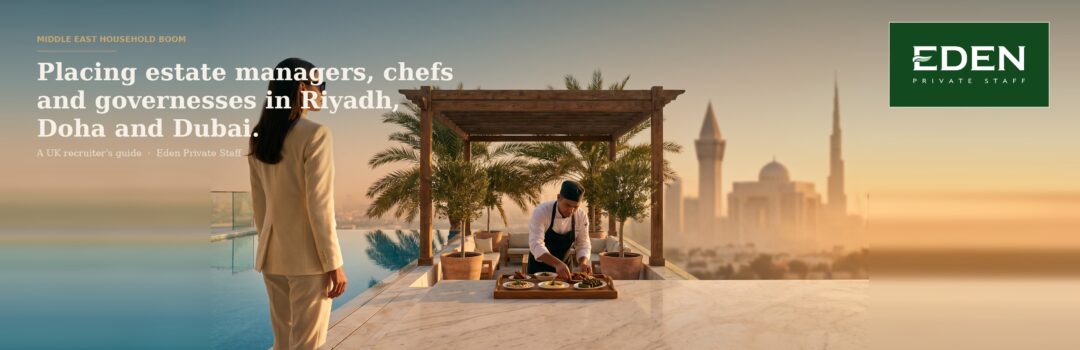
The Middle East Household Boom:
A UK Recruiter’s Guide to Placing Estate Managers, Chefs and Governesses in Riyadh, Doha and Dubai
The Middle East is no longer a secondary destination in international private staff recruitment.
For many Estate Managers, Private Chefs, Governesses, Nannies, Household Managers and private PAs, Dubai, Riyadh and Doha now represent some of the most significant appointments in the global market.
At the same time, families across the Gulf are increasingly looking to London, Europe and the United States for private staff with established HNW/UHNW household experience, internationally recognised training, strong references and the confidence to work across several residences.
The opportunities are considerable, but these Searches require close attention and successfully hiring international private staff in the Middle East depends on five things being aligned before the Search even begins:
- The true scope and seniority of the role
- The correct employing and sponsorship structure
- A complete salary and benefits package
- Cultural and household compatibility
- Sustainable arrangements for travel, leave and safeguarding
When any of these elements are missing, even an attractive salary can fail to secure or retain the right candidate.
Why Demand for Senior Private Staff Is Rising
The growth of private household recruitment is connected to the wider professionalisation of private wealth and Family Offices across the region.
Dubai International Financial Centre reported that the number of family-related entities within its ecosystem rose by 61% during 2025 to reach 1,289. Its’ wealth and asset-management community also expanded to more than 500 firms.
Qatar Financial Centre has developed specific structures for Single and Multi-Family Offices, while Saudi Arabia’s economic transformation continues to attract international businesses, advisers, executives and private capital to Riyadh. (DIFC)
Household demand does not follow Family Office growth in a simple one-to-one ratio. It does, however, follow the same underlying change.
More internationally mobile Principals create more residences, more complex travel, more formal governance and greater demand for professionals who can connect the household with the Family Office.
The result is rising demand for roles including:
- Estate Managers and Directors of Residences;
- Executive and Private Chefs;
- Governesses, private educators and rota childcare professionals;
- Household Managers and Butlers;
- private PAs, EAs and Chiefs of Staff;
- security-aware Chauffeurs;
- travelling Nannies and Maternity Nurses; and
- professionals capable of coordinating several homes internationally.
The GCC private staffing market is therefore not simply growing in headcount. It is becoming more specialised.
Dubai, Riyadh and Doha Are Not One Market
“Middle East experience” is often treated as a single candidate requirement.
In reality, the operating environment can differ considerably between cities and between individual families.
| Market | Common characteristics of senior household briefs | Questions to resolve before recruitment |
| Dubai | Highly international households, substantial global travel, luxury villas and apartments, close links between household and Family Office, greater availability of live-out candidates | Housing allowance, travel frequency, correct sponsor, transport, working pattern and whether the role serves the household, Family Office or both |
| Riyadh | Large residences or compounds, formal reporting structures, substantial household teams, high levels of privacy, family and business interests closely connected | Chain of command, precise occupation and visa route, accommodation, working hours, decision-making authority and cultural orientation |
| Doha | Highly private family environments, international education, formal service, multi-residence lifestyles and significant interaction with advisers and security teams | Personal sponsorship route, residence permit, educational remit, household hierarchy, travel expectations and operational support |
These are broad recruitment patterns, not descriptions of every household.
A relaxed Dubai family may operate more formally than a Riyadh household. A Doha Principal may maintain a smaller and less hierarchical team than a London family.
The recruiter’s task is not to place the family into a cultural category. It is to establish how that particular household operates.
2026 Package Norms for Senior International Private Staff
Compensation in the GCC should be assessed as a complete package rather than as salary alone.
The following are Eden Private Staff’s indicative 2026 planning bands for senior, internationally recruited professionals working within HNW, UHNW, Royal or similarly complex private households.
They are not general domestic-worker wage levels, guaranteed offers or legal minimums.
| Role | Dubai | Riyadh | Doha |
| Estate or Residences Manager | AED 35,000–65,000+ per month | SAR 40,000–75,000+ per month | QAR 35,000–65,000+ per month |
| Private or Executive Chef | AED 20,000–60,000+ per month | SAR 25,000–60,000+ per month | QAR 22,000–55,000+ per month |
| Governess or Private Educator | AED 25,000–45,000+ per month | SAR 28,000–50,000+ per month | QAR 25,000–45,000+ per month |
Directors of Residences, Executive Estate Chefs, specialist SEN Governesses and rotational professionals with substantial international responsibility may exceed these ranges.
Eden’s published international guidance places GCC Governess packages broadly within a £70,000–£120,000 equivalent range with benefits. Dubai Private Chef guidance extends from approximately AED 240,000 for family-style appointments to AED 720,000 or more for Executive Estate Chefs. (Eden Private Staff)
The amount should always be tested against:
- days and hours;
- live-in or live-out status;
- level of international travel;
- rota or permanent structure;
- property and team size;
- specialist qualifications;
- dietary, educational or language expertise;
- formal entertaining;
- management responsibility; and
- the degree of flexibility genuinely required.
What Should a GCC Private Staff Package Include?
A competitive package may include:
- private accommodation or a housing allowance;
- residence visa and work-authorisation costs;
- health insurance;
- relocation and initial flight costs;
- an annual return flight;
- local transport, a car or driver support;
- agreed paid leave and weekly rest;
- travel expenses and per diems;
- a performance or retention bonus;
- end-of-service entitlements; and
- emergency repatriation arrangements.
Accommodation must be described accurately.
“Private accommodation provided” could mean a self-contained apartment, a room in a staff property, a bedroom within the Principal’s residence or shared accommodation.
Those arrangements are not equivalent from a candidate’s perspective.
Similarly, “all travel included” should clarify whether flights, hotels, meals, ground transport, visas and travel days are covered.
The Local Tax Advantage Requires a UK Tax Warning
Employment salaries are generally not subject to local personal income tax in the UAE, Saudi Arabia or Qatar. This makes GCC appointments commercially attractive to many internationally mobile candidates. (PwC Tax Summaries)
However, a UK candidate should not assume that accepting a locally untaxed salary automatically removes every UK tax obligation.
UK residence is determined under the Statutory Residence Test, taking account of time, work and connections to the UK. Split-year treatment applies only where its conditions are met. Candidates should obtain individual tax advice, particularly when retaining a UK home, returning regularly or working part of the year in Britain. (GOV.UK)
The package should therefore state whether the salary is:
- gross under the local contract;
- locally free of personal income tax;
- subject to deductions or social obligations;
- accompanied by any tax advice; and
- protected against unexpected liabilities—or expressly not protected.
“Tax-free” should never be used as a substitute for proper tax-residence analysis.
How the Estate Manager Role Changes in the GCC
A UK Estate Manager may be responsible for a country estate, several domestic departments, contractors, grounds, maintenance and property budgets.
In the Gulf, the same title can carry a much broader mandate.
A senior Estate Manager may oversee:
- several residences, guest properties and compounds;
- large, multilingual household teams;
- House Managers, Butlers, Chefs, Chauffeurs and housekeeping departments;
- property systems, maintenance and capital projects;
- procurement and approved suppliers;
- vehicle fleets and travel movements;
- formal entertaining and high guest volumes;
- coordination with security teams;
- household expenditure and reporting;
- international residence preparation; and
- communication with the Family Office.
The role may therefore be closer to Director of Residences than traditional House Manager.
The Brief must specify which level is genuinely required.
A candidate cannot be expected to carry strategic accountability for a multi-property portfolio while being given the authority, support or title of a hands-on supervisor.
Reporting lines are particularly important. A senior manager needs to know whether instructions come from the Principal, another family member, a Chief of Staff, the Family Office, a senior household representative or several of them.
Without a clear hierarchy, even an excellent Estate Manager can become trapped between competing instructions.
How the Private Chef Brief Changes
A Gulf Private Chef Brief may combine family dining, nutrition, formal entertaining and international travel.
The first question should not be: “Does the candidate have Michelin experience?”
It should be: “What food service does this family actually need?”
The answer may include:
- daily family-style meals;
- Arabic, Asian, European or international cuisine;
- formal dinners and significant guest entertaining;
- specialist children’s food;
- sports, longevity or wellness nutrition;
- allergen-controlled cooking;
- halal sourcing and kitchen protocols;
- Ramadan, iftar and suhoor service;
- provisioning across several residences;
- management of sous chefs and kitchen assistants; and
- travel on private aircraft, yachts or to seasonal homes.
A Michelin-trained Chef may be ideal for a household with formal entertaining and technically complex cuisine.
They may not automatically be the best family Chef.
Conversely, a warm, adaptable Chef who understands children, nutrition and daily household rhythms may outperform a more decorated restaurant candidate in a family-led role.
Cultural competence also matters. The Chef does not need to arrive knowing every family recipe, but they must demonstrate curiosity, respect and the ability to learn the Principal’s preferences without imposing their own culinary identity.
How the Governess Role Changes
A Governess is usually recruited for education, development and pastoral support—not general domestic childcare.
The GCC Governess Brief commonly includes:
- British or international curriculum support;
- phonics, literacy and numeracy;
- school and tutor liaison;
- homework and exam preparation;
- language development;
- manners, confidence and independence;
- educational activities during travel;
- SEN or behavioural support;
- coordination with Nannies and household staff; and
- continuity between several homes and schools.
The distinction between Nanny and Governess must remain clear.
A Governess may provide warmth, supervision and age-appropriate care, but a family should not advertise an educational appointment and then expect full nursery duties, housekeeping and continuous childcare.
Where younger children require both care and education, a properly designed Nanny-Governess role may be appropriate.
Where the family requires near-continuous coverage, it may need two rota professionals rather than one permanently available employee.
Visa and Residence Routes: The Correct Structure Comes First
Eden can identify candidates and support the international recruitment process, but the employing family and its authorised local advisers must confirm the correct immigration route.
A candidate should not begin work on a visit or tourist status.
Dubai and the UAE
The UAE Ministry of Human Resources and Emiratisation provides the domestic-worker work-permit route for eligible household employers. The process interacts with the relevant immigration authority for entry and residence arrangements.
Requirements and permit periods can vary according to whether the sponsor is a UAE national, GCC national, resident, investor, diplomat or qualifying visa holder. (MOHRE)
The critical issue for senior roles is classification.
A Chef or Governess working exclusively for a personal household may fall within a personal household sponsorship route.
An Estate Manager carrying out genuine work for a Family Office, company, commercial property operation or corporate entity may require an employment route attached to that organisation.
The contract title, permitted occupation and actual duties must therefore align.
Riyadh and Saudi Arabia
Saudi Arabia uses the official Musaned platform for domestic-worker recruitment processes, including domestic-worker visas, contracts and salary-payment tracking.
Following arrival, the sponsor must complete the relevant medical and residence procedures, including the employee’s Iqama. (Musaned)
Again, the correct occupation matters.
A household appointment should not quietly expand into work for an operating company, commercial estate or unrelated family business when the employee is sponsored for a personal domestic role.
Where the position genuinely crosses into a Family Office, the family should obtain local advice on whether a company employment route is more appropriate.
Doha and Qatar
Qatar’s Ministry of Interior provides a household-worker entry visa under personal sponsorship.
Published requirements include an employment contract, police-clearance documentation and the relevant medical procedures. A first-time residence permit is then completed through the personal sponsorship process. (MOI Qatar – Ministry of interior Qatar)
Qatar’s domestic-worker framework also addresses written contracts, accommodation, healthcare, wages, rest, leave and end-of-service provisions. (Encyclopaedia)
The Cross-Border Travel Trap
A residence visa for Dubai, Riyadh or Doha does not automatically authorise the employee to work in the UK, Europe, the United States or another country.
For travelling roles, the family must consider every material destination.
The contract should establish:
- the employee’s principal place of work;
- expected countries and approximate travel days;
- who obtains and pays for visas;
- whether travel days are working days;
- rest after overnight journeys;
- accommodation standards;
- medical and travel insurance;
- what happens when entry permission is delayed; and
- whether the employee may decline travel that would breach immigration rules.
A household should never rely on repeated tourist entry as an informal substitute for proper work authorisation.
Cultural and Religious Fit Is an Operating Requirement
Cultural fit does not mean recruiting according to stereotypes or assuming that every GCC family operates in the same way.
It means ensuring the candidate can work respectfully within the family’s actual environment.
That may require an understanding of:
- household hierarchy and appropriate communication;
- privacy between different family and guest areas;
- prayer times and religious observance;
- Ramadan routines;
- modest presentation;
- formal guest protocols;
- food and beverage restrictions;
- appropriate photography and social-media behaviour; and
- the importance of family reputation and confidentiality.
Saudi Arabia, Qatar and the UAE each have local laws and cultural expectations that differ from the UK. Candidates should receive a proper local orientation and consult current official travel and legal guidance before relocation. (GOV.UK)
Respect must work in both directions.
The employee should approach the household with cultural intelligence. The household should provide clear expectations, proper working conditions, suitable private accommodation and the ability to raise concerns through a defined route.
Safeguarding Governesses and Children Across Borders
Safeguarding standards should become stronger—not weaker—when a childcare professional relocates internationally.
A robust Governess or Nanny Search should include:
- identity and right-to-work verification;
- enhanced DBS checks where available and relevant;
- police-clearance certificates from other countries of residence;
- qualification verification;
- detailed, independently obtained references;
- current paediatric first aid;
- safeguarding training;
- scenario-based interviews;
- social-media and digital-discretion assessment; and
- a structured trial where appropriate.
A UK DBS certificate is useful, but it is not a complete international background history.
The family should also provide a written safeguarding framework covering medical consent, medication, photographs, swimming, drivers, authorised adults, travel, overnight arrangements and escalation.
The employee must know who to contact if a concern relates to the person who normally manages them.
Confidentiality should never be interpreted as preventing an appropriate safeguarding report.
This section should cross-link to Eden’s UHNW Nanny Recruitment Playbook, which explains why elite childcare recruitment should be treated with the discipline of Executive Search. (Eden Private Staff)
Which Travelling-Staff Model Works Best?
Three structures are particularly relevant to GCC families.
Resident professional with international travel: The employee is based primarily in Dubai, Riyadh or Doha and accompanies the family for agreed periods.
Rotational appointment: Two professionals work an agreed rota, such as one or two weeks on and off. This provides greater continuity where extensive availability is required.
UK-anchored international appointment: The employee retains a UK base but spends defined blocks of time in the Gulf and at other family residences.
Each model can work.
The problem arises when the contract describes one model and the family operates another.
A permanent employee cannot sustainably be treated as though they are always on duty. A rota candidate cannot be expected to surrender scheduled rest whenever the itinerary changes. A UK-anchored professional cannot be promised regular time at home if the family’s real schedule makes that impossible.
Eden’s live international Briefs demonstrate the importance of defining residence patterns, travel months, private accommodation and visa support from the beginning. (Eden Private Staff)
Why UK-Trained Candidates Command a Premium
UK-trained and UK-experienced candidates often attract strong GCC interest because they may bring:
- recognised private-household experience;
- British curriculum knowledge;
- established safeguarding practices;
- formal service or estate-management standards;
- Michelin, luxury hospitality or specialist culinary training;
- experience with multiple residences;
- strong English-language communication;
- internationally checkable references; and
- confidence working with Family Offices and professional advisers.
However, the premium should attach to verified capability, not nationality or passport.
A British passport alone does not make someone a stronger Estate Manager, Chef or Governess.
Locally based and regionally experienced candidates may offer valuable Arabic language ability, cultural fluency, trusted supplier networks and a sophisticated understanding of how Gulf households operate.
The strongest appointment may combine international training with extensive regional experience.
In larger households, the best structure often blends senior international specialists with excellent locally and regionally recruited professionals.
Eden Private Staff’s GCC ‘READY’ Recruitment Framework
Before approaching candidates, Eden recommends testing the appointment through eight questions.
| Principle | Question |
| G — Governance | Who is the legal employer and who has authority over the role? |
| C — City and culture | How does this particular household operate in Dubai, Riyadh or Doha? |
| C — Compensation | What is the complete value of salary, accommodation, medical cover, flights, leave and bonuses? |
| R — Role | What is the primary function, and what duties are expressly outside it? |
| E — Entry | Which work-permit, sponsorship and residence route applies? |
| A — Accommodation and availability | Where will the employee live, and when are they genuinely off duty? |
| D — Duty of care | What employment, welfare and safeguarding protections are in place? |
| Y — Year-round continuity | Who covers leave, sickness, travel disruption and changes of residence? |
This process prevents the most common international recruitment problem: finding an excellent candidate for a role that was never operationally viable.
Recruit Internationally, Brief Locally
The Middle East offers outstanding opportunities for private staff.
It also gives families access to a global candidate market encompassing London, Europe, the United States, Asia and experienced professionals already based within the GCC.
Success depends on combining that international reach with a precise understanding of the local household.
Eden Private Staff recruits across the complete private household and Family Office structure, including Estate Managers, Directors of Residences, Private Chefs, Governesses, Nannies, Household Managers, Butlers, Domestic Couples, Chauffeurs, private PAs, EAs, Chiefs of Staff and senior Family Office professionals.
For more than 25 years, Eden has supported HNW and UHNW families with discreet, international private staff recruitment focused on judgement, suitability and long-term fit. (Eden Private Staff)
The objective is not simply to move a candidate from the UK to the Gulf.
It is to build an appointment that works for the family, the employee and the household across countries, cultures and years.
Frequently Asked Questions
How much does an Estate Manager earn in Dubai in 2026?
Senior internationally recruited Estate Managers may broadly command AED 35,000–65,000 or more per month. Directors of Residences overseeing several properties, large teams, projects and significant budgets may exceed this range.
How much does a Private Chef earn in Riyadh?
An experienced international Private Chef may command approximately SAR 25,000–60,000 or more per month. The highest packages are generally attached to Executive Chefs managing kitchen teams, formal entertaining, specialist nutrition or extensive travel.
What is a typical GCC Governess salary?
Senior Governess and private-educator packages commonly fall within a broad equivalent of £70,000–£120,000 annually, frequently with accommodation, visa, medical insurance and flights. SEN expertise, formal teaching credentials, languages and rota work can increase the package. (Eden Private Staff)
Can a UK citizen work in Dubai, Riyadh or Doha?
Yes, subject to obtaining the correct local work authorisation, sponsorship and residence documentation. A tourist or visit entry should not be used as a substitute for permission to work.
Are salaries tax-free in the Gulf?
The UAE, Saudi Arabia and Qatar do not generally impose local personal income tax on employment salaries. However, a UK candidate may still have UK tax obligations depending on residence, UK ties and working days. Individual professional advice is essential. (PwC Tax Summaries)
Should a Governess be sponsored as a domestic worker?
That depends on the permitted local occupation, actual responsibilities and employing structure. A Governess working solely within the personal household may use a household sponsorship route where available. A role attached to a Family Office or commercial organisation may require a different route.
Is a UK DBS check sufficient for an international Governess?
Not on its own. Families should also consider identity verification, overseas police certificates, qualification checks, independently obtained references, safeguarding assessment and checks covering every relevant country of residence.
Can Eden recruit an entire GCC household team?
Yes. Eden Private Staff recruits individual professionals and coordinated teams across private households, estates, childcare, executive support and Family Offices in the UK, the Middle East and internationally.
This article provides general recruitment and market guidance. Immigration, employment, tax and safeguarding arrangements should be confirmed by appropriately qualified advisers in the relevant jurisdiction.
At Eden Private Staff, we have been placing Maternity Nurses, Nannies, Governesses, House Managers, Chauffeurs, Personal Assistants, Executive Assistants, Gardeners, Domestic Couples, Allrounders & All family office professionals with HNW & UHNW families for nearly 30 years. If you are preparing to hire and would like guidance on structuring your process, we are happy to help.
You can contact Eden Private Staff on +44 (0) 2074716000 or email info@edenprivatestaff.com

